What is AI?
What is AI?
What is Artificial Intelligence?
Artificial Intelligence (AI) is a branch of computer science that involves the development of systems and machines that can analyze data and make inferences, simulate human thought processes, and execute advanced strategies. In simple terms, the ultimate goal of AI is to enable computers to have human-like thinking and judgment abilities.
Origins of Artificial Intelligence
But how did AI come about? Humans have long imagined the possibility of creating machines that can rival the human brain. Alan Turing, considered the father of artificial intelligence, posed the question ‘Can machines think?’, spurring people to contemplate the possibilities of electronic brains.
In 1956, John McCarthy and other scholars coined the term ‘artificial intelligence’, which further expanded the discussion and research on the topic. After decades of effort, research on machine learning, deep learning, and pattern analysis emerged, assisting humans in breaking through application boundaries and creating the diverse range of AI applications we see today.
In 1956, John McCarthy and other scholars coined the term ‘artificial intelligence’, which further expanded the discussion and research on the topic. After decades of effort, research on machine learning, deep learning, and pattern analysis emerged, assisting humans in breaking through application boundaries and creating the diverse range of AI applications we see today.
Pros and Cons of AI
AI technology is rapidly advancing, mainly due to its ability to quickly transform large amounts of data and assist in analyzing potential problems, thus improving labor productivity. However, like all innovative technologies, new technologies bring both benefits and potential negative impacts. While AI can quickly interpret vast amounts of data and assist in increasing operational efficiency, the cost of processing large amounts of data using AI is also relatively high.
Advantages of AI
- Possible to process vast amounts of data in a short amount of time
- Works consistently and continuously, without interruption or deviation
- Less prone to errors, effectively reducing human error caused by lack of concentration
Disadvantages of AI
- Effectiveness depends on the system and the quality and volume of data
- High development costs and expertise required to develop systems
- Limited availability of professionals with technical AI skills and experience
What is Weak AI? What is Strong AI?
AI can be divided into two broad classifications: ‘weak AI’, also known as Artificial Narrow Intelligence (ANI), and ‘strong AI’, also known as Artificial General Intelligence (AGI).
Artificial Narrow Intelligence
ANI is a type of AI that can simulate some human thinking and behavior in a specific area, such as facial recognition, language translation, and automatic navigation. ANI is not sentient and is currently the most common application of artificial intelligence.
Artificial General Intelligence
AGI refers to computers that have sentience and possess human-like intelligence such as learning ability, language ability, and logical thinking ability. AGI currently exists only in sci-fi novels and movies, although some experts predict that AGI could be achieved in the next 10-20 years.
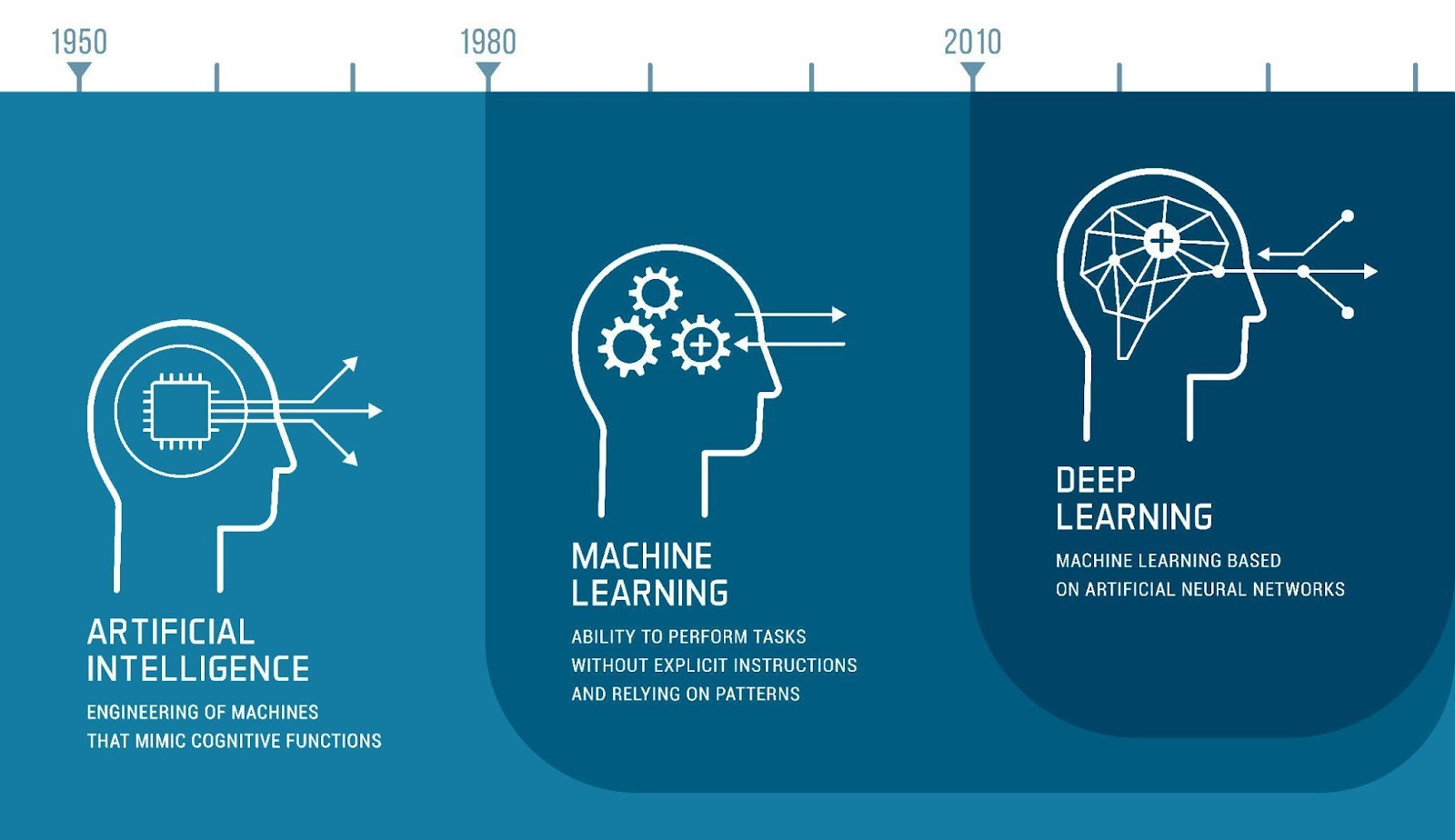
Machine Learning, Deep Learning, and AI: What’s the Difference?
After understanding the definition of AI, have you ever wondered why terms like machine learning (ML) and deep learning (DL) are often associated with AI and what the relationship is between them?
What is Machine Learning?
Machine learning is a branch of artificial intelligence that uses large amounts of data to train systems using various algorithms to improve and create models to provide answers and feedback.
What is Deep Learning?
Deep learning is a subfield of machine learning that uses a neural network structure inspired by the human brain to create layered algorithm structures that can independently learn and make decisions.
How Does Machine Learning and Deep Learning Help Industry?
With the rapid advancement of technology in recent years, information systems and machines have been widely used in various industries. AI has also risen to prominence, successfully impacting finance, manufacturing, telecommunications, software, and other fields.
In manufacturing, machine learning and deep learning have been vital in optimizing production processes, reducing waste, and improving product quality. By analyzing data from sensors and machines, companies can identify areas of improvement and make changes to increase efficiency and decrease costs.
By leveraging AI-based technologies, companies can gain valuable insights, make better decisions, and improve their operations. As AI technologies continue to evolve, we can expect to see even more innovative applications in the future.
In manufacturing, machine learning and deep learning have been vital in optimizing production processes, reducing waste, and improving product quality. By analyzing data from sensors and machines, companies can identify areas of improvement and make changes to increase efficiency and decrease costs.
By leveraging AI-based technologies, companies can gain valuable insights, make better decisions, and improve their operations. As AI technologies continue to evolve, we can expect to see even more innovative applications in the future.